001 - A Maritime Prehistory of the Mediterranean
Introduction
If we could drain the Mediterranean, we would find the remains of villages, harbors, and beaches that were centers of human activity 20,000 years ago. Places where our ancestors lived, built their first communities, and launched their first boats. You see, roughly 150,000 square miles of ancient coastline now lie beneath the waves due to sea-level rise.
Maybe this sounds a bit far-fetched, but I promise, it isn’t. Let’s visit southern France to see just one example. In 1991, after six years of dangerous dives through a 600-foot underwater tunnel off the coast, diver Henri Cosquer finally emerged into an air-filled chamber that had remained above the waterline despite sea-level rise. Inside, he found a time capsule of prehistoric art covering the cave walls—hand stencils, horses, bison, even the now-extinct auroch. Twenty thousand years ago, when ancient humans painted these walls, the cave sat several miles inland, its entrance 330 feet above sea level. Today, that entrance is 120 feet underwater.
Over millennia, the Mediterranean had swallowed it whole.
Welcome to the Maritime History Podcast. I'm Brandon Huebner, and today we're diving into Episode 001: A Maritime Prehistory of the Mediterranean. If you're a returning listener, you'll notice this is a revamped and rebooted version of the original episode—part of my effort to refresh the entire series.
With the background context of sea-level rise and climate change in the ancient past, today we’re going to explore what else we can learn about the ancient Mediterranean and how early humans related to it.
We'll also tackle the overall question of how boats changed human history. Without those first fragile vessels, things like reed rafts, dugout canoes, and even floating platforms; without those farming never spreads to the islands. Cyprus remains uninhabited, Crete stays empty, and Malta never sees a human footprint. On some level, the early trajectory of Mediterranean civilization rested on anonymous prehistoric paddlers risking their lives on open water.
Over this season, we'll trace how these first fragile reed rafts evolved into the sophisticated ships that connected Bronze Age civilizations—from Egyptian expeditions to Punt, to Minoan trade networks, to the Mycenaean galleys that would raid Troy. But it all starts here, 30,000 years ago, when humans first overcame their fear of deep water.
Today I’m drinking a super fruity anaerobic processed Rwanda coffee, roasted by Red Rooster Coffee in Floyd, Virginia. The process of fermenting the coffee cherries before they are removed and later dried and roasted gives this coffee an intensely fruity flavor, really unique. Check out Red Rooster if you’re so inclined, they have many other good varieties to choose from.
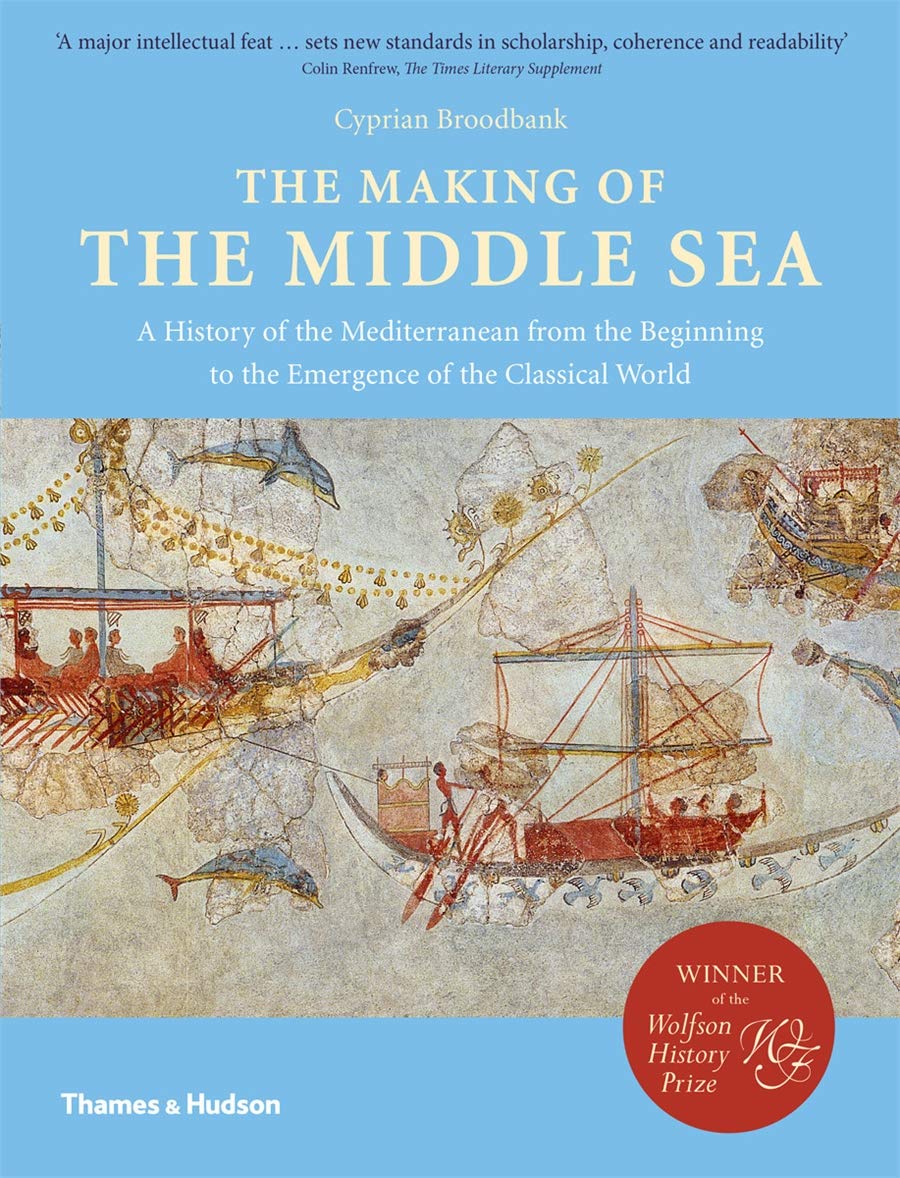
Today's episode draws heavily from Cyprian Broodbank's The Making of the Middle Sea, which is probably the most comprehensive recent synthesis of Mediterranean maritime prehistory. Broodbank What I love about his work is how he pieces together incredibly fragmentary evidence—a few obsidian blades here, some fish bones there—to reconstruct when and how humans first ventured onto the sea. He's also refreshingly honest about what we don't know. There's still massive debate about dates and routes, and Broodbank doesn't pretend to have all the answers. But his arguments are careful, his evidence is thorough, and reading him gives you a real sense of how challenging maritime archaeology is when you're dealing with sites that are 10,000 years old.
Anyway, let's dive in.
ACT 1: THE SUBMERGED WORLD (30,000-12,000 BCE)
The Greek philosopher Plato once compared ancient Mediterranean peoples to "ants or frogs around a pond." Even 2,500 years ago, he recognized something fundamental in the way humans are drawn to water. From there, we live around its edges, and eventually, we always seem to venture out onto the water.
But to understand when and why that first happened, we need to grasp just how different the Mediterranean once was.
During the Last Glacial Maximum—roughly 30,000 to 16,000 BCE—global sea levels were 400 feet lower than today. The Mediterranean wasn't as dramatically affected as some regions, but archaeologist Cyprian Broodbank estimates that 300,000 to 400,000 square kilometers that would have been dry land 30,000 years ago are now underwater. That's the same square area as all of Germany, now mostly inaccessible for study.
To state the obvious, sea-level rise poses a major challenge for anyone trying to understand prehistoric maritime history. The evidence is submerged. The shorelines where our ancestors first launched boats are now dive sites.
That's where nautical archaeology becomes crucial. Modern technology, from advanced diving equipment to sonar and submersibles, now allows researchers to study sites that have been inaccessible for tens of thousands of years. And what they're finding is rewriting what we thought we knew.
Take Cosquer Cave, where we started. The art inside is remarkable, but from our perspective, the cave itself is the real story. It's physical proof of how radically sea levels have changed. A place that was once miles inland and hundreds of feet above sea level is now accessible only to technical divers. The sea rose roughly 450 feet at that location alone.
Or consider La Draga, a Neolithic village on the shore of Lake Banyoles in Catalonia. Part of the site remained above water, but much of it was submerged. The silt and mud below the waterline preserved organic materials that normally decompose within decades: wheat, peas, fruit, nuts, wooden bowls, baskets, yew bows, dogwood arrows. Without water burial, all of this would be dust. With it, we get a window into daily life.
Now, there are some places where even nautical archaeology struggles. The Nile Delta, for instance—crucial to understanding Egypt's relationship with the Mediterranean—is buried under millennia of silt buildup. Many of the oldest sites there are beneath the water table, effectively sealed off from excavation. So our picture of the past will always be incomplete.
But here's what we can say with confidence: for a very long time, early humans were not fans of large bodies of water. Broodbank's memorable phrase is that it was "far from a case of love at first sight." And honestly, that makes sense. The sea is terrifyingly unpredictable. Ancient humans had every reason to stay on solid ground.
That brings us to really our main question today: how did they overcome that fear? And when exactly, if we can even tell?
The answer varies wildly depending on where in the world you look. In Southeast Asia, stone tools found on islands prove that hominins were crossing 12 to 15 miles of open ocean as far back as 800,000 years ago. In northern Australia, homo sapiens colonized the landmass known as Sahul around 65,000 years ago—a journey requiring multiple open-water crossings, including at least one stretch of over 40 miles where land would have been completely out of sight. Some scholars call this "the world's first great maritime journey."
But in the Mediterranean? It seems that humans took longer to take the plunge.
Neanderthals lived along Mediterranean shores, and there's circumstantial evidence they may have made short crossings. The problem is that changing sea levels make it difficult to determine which islands were actually islands 100,000 years ago versus peninsulas still connected to the mainland. We know some islands were always islands because of telltale signs—like the dwarf elephant fossils found on Delos, Sicily, Sardinia, Crete, Cyprus, and Malta. These elephants evolved in isolation, literally trapped when rising seas cut their islands off from the mainland.
A few larger Aegean islands like Kefalonia and Melos show evidence of Neanderthal stone tools, and since these islands were likely never connected to the mainland, the toolmakers must have crossed water to reach them. More controversially, quartz hand-axes discovered on Crete might push back the timing of hominin seafaring in the Mediterranean to before 130,000 BCE, though that research is still debated.
The bottom line: both Neanderthals and homo sapiens did venture onto the water, probably using crude floating platforms, dugout canoes, or reed rafts. These were coastal hunter-gatherers making short hops to nearby islands, probably foraging for resources they couldn't find on the mainland. None of it was systematic. None of it was routine trade. It was opportunistic island-hopping at best.
So when does seafaring become something more deliberate, more regular? When can we start calling it actual maritime culture?
The answer: around 12,000 BCE, at the beginning of the Mesolithic period. And we know this because of a very particular type of volcanic glass.
ACT 2: THE OBSIDIAN NETWORK (12,000-7,000 BCE)
The main challenge to any study of prehistoric maritime activity is the fragility of organic material. We’ll get into it more, but the reality is that boats made from reeds or even wood rot away within decades or centuries. We have almost no physical remains of vessels from this period. So how do we know people were traveling by sea with increasing frequency?
We sketch out a network of movement and trade by tracing the materials that humans carried around with them, and some materials work better for this purpose than others.
Before metals entered the archaeological record, one material stands out: obsidian. This black volcanic glass forms when lava cools rapidly, and it was prized by Mesolithic peoples because it could be shaped into razor-sharp blades that held their edge far better than most stone. The Roman naturalist Pliny the Elder described it as a dark, sometimes transparent glass used for mirrors, jewelry, and even—remarkably—a life-sized statue of Emperor Augustus.
But here's what makes obsidian invaluable to archaeologists: every volcano has a unique mineral composition, which means every piece of obsidian carries a chemical fingerprint of its birthplace. Modern technology can trace any obsidian artifact back to its source volcano. When you find obsidian on an island with no volcanoes, you know with absolute certainty that someone transported it there.
And obsidian starts showing up everywhere around 12,000 BCE.
Let's look at the island of Cyprus. By 11,000 BCE, Cyprus was separated from Anatolia, the nearest mainland, by at least 40 miles of open water, and from the Levant by 60 miles. There are no stepping-stone islands to make this an easy journey. Anyone crossing to Cyprus during this period would have had to paddle, float, or sail the entire distance, likely spending multiple days at sea. And yet, we find human settlements on Cyprus from this era. We also find obsidian, which doesn't occur naturally on the island. Someone was making regular crossings to bring it from Anatolia.
But the most revealing obsidian story comes from the Aegean, specifically from an island called Melos.
Melos lies in the Cyclades, southwest of the Aegean proper, and due north of Crete. It has natural obsidian sources, and evidence shows humans were accessing that obsidian as early as 13,000 BCE, which represents the oldest direct evidence of seafaring by anatomically modern humans in the Mediterranean. But Broodbank emphasizes that this is surely just the tip of the iceberg. Much more maritime activity was likely happening that we simply haven't found evidence for yet.
Now here's where it gets interesting. About 75 miles from Melos as the crow flies, on the Greek mainland in Argolis, there's a place called Franchthi Cave. At Franchthi, archaeologists have found Melian obsidian dating to between 13,000 and 12,000 BCE.
For that obsidian to get to Melos, some ancient humans would have spent several days gradually boating there, island-hopping across a chain of small Cycladic islands, paddling exposed to wind and waves. All with the aim of obtaining volcanic glass for better tools.
To understand how this was possible, archaeologists have turned to experimental archaeology—the practice of recreating ancient conditions and technologies to see what would actually have been feasible.
In the 1980s, researchers built a traditional reed boat called a papyrella, based on designs that survived in various Mediterranean cultures into the modern era. They used only materials and tools available to Mesolithic peoples: papyrus reeds cut with stone blades, natural rope for lashing. The resulting vessel was about 20 feet long. Similar reed boats appear in ancient Mesopotamia and Egypt, and variations are still used in some cultures today—Lake Titicaca in South America, for instance.
The experimental voyage proved successful. Six rowers made five sea crossings of roughly 10-12 miles each, island-hopping from mainland Greece toward Melos. They faced challenging winds and rough conditions but completed the journey in seven days, carrying obsidian cargo back. A full round-trip expedition in ancient times might have taken a month.
These were serious undertakings, many times requiring multiple days at sea in fragile vessels, at the mercy of weather, with real risk of capsizing and drowning. And this was happening during the Younger Dryas, a period of severe cold and arid conditions from roughly 12,900 to 11,700 before present.
Broodbank makes a crucial observation here: "Mediterranean seafaring began in hard, not halcyon times, and this, in turn, forces a rethink as to why people started to practice it." These weren't pleasure cruises or casual exploration. Rather, due to climate change, people were under environmental stress. Populations had been growing during warmer periods, and when conditions deteriorated, they needed options. Islands became refuges where small groups could survive when mainland resources grew scarce.
Obsidian gave them a reason to take the risk. But the environmental pressure made it more or less necessary.
As we move through the Mesolithic, we see obsidian trade expanding but remaining localized. Obsidian from Aegean sources doesn't appear in Italy. Italian obsidian from the Tyrrhenian Sea—near islands like Lipari—doesn't travel east. These are regional networks, not Mediterranean-wide trade routes. People made deliberate voyages to obtain specific materials, but the scale was limited to a few dozen miles in most cases.
Most of these crossings would have kept land in sight. From the perspective of ancient seafarers, these were bold expeditions into dangerous territory. But from our perspective, looking back, they're not quite true "seafaring" in the sense of multi-day open-ocean voyages completely beyond sight of land.
In our jaunt through history, though, that’s now about to change.
ACT 3: ISLANDS COME ALIVE (7,000-3,000 BCE)
Around 7,000 BCE, something shifts dramatically across the Mediterranean. Maritime activity doesn't just increase—it transforms. And the catalyst isn't better boats or navigational innovation.
It's farming.
The development of agriculture began on the mainland, where there was space, larger populations, and the critical mass of people needed for such a revolutionary innovation to take hold. But once farming was established, the idea and the materials needed to pull it off could be transported. When farming arrives on an island that can support it, everything changes. Suddenly, living year-round on an island becomes possible in a way it never was for hunter-gatherers dependent on wild game and seasonal foraging.
One notable thing we’ve gradually learned is that in several of the larger Mediterranean islands—Cyprus, Crete, Sicily—we find evidence that domesticated farm animals arrived before those same animals had spread to equivalent latitudes on the mainland. In other words, maritime transport was often faster than overland migration. Boats were accelerating the spread of one of humanity's most important innovations.
This creates a feedback loop. Better, more regular maritime transport enables farming to spread to islands. Farming on islands creates stable communities that build more boats and develop better seafaring skills. Those boats then facilitate even more trade and movement. Each development reinforces the other.
The best example of this Neolithic maritime explosion is the island of Lipari.
Lipari lies just north of Sicily in the Tyrrhenian Sea, part of the volcanic Aeolian island chain. Like Melos in the Aegean, Lipari has natural obsidian sources. But unlike earlier periods, by around 5,000 BCE we see something unprecedented: an entire community of at least 100 people living on the island year-round, centered on an elevated site overlooking a natural harbor.
The archaeological evidence is stunning. We find ovens, debris from obsidian blade production, stone axes, grinding stones, and large quantities of pottery. Broodbank paints an evocative picture of what might have been happening on Lipari: "One attractive interpretation of this strange accumulation is that it reflects the residues of seasonal gatherings of strangers as well as locals, drawn by the magnet of obsidian but also the chance to trade, feast, socialize and swap news in the midst of the sea with people from far away."
In other words, Lipari may have functioned as a proto-trading hub—a place where groups from across the region gathered periodically, drawn by obsidian but staying for the social and commercial opportunities. This kind of maritime meeting point was "unthinkable a millennium earlier," Broodbank notes, and represents "the start of the Mediterranean islands' coming of age."
But all of this raises an obvious question: what were people using to transport farming equipment, livestock, pottery, and obsidian?
Reed boats would have been in continuous use, no doubt, but they have serious limitations. They're not particularly seaworthy in rough conditions, and they can't carry heavy loads far offshore. For the kind of maritime activity we're seeing in the Neolithic, something more robust was needed.
Enter the dugout canoe—or logboat, or as the ancient Greeks called it, the monoxylon.
These vessels were carved from a single tree trunk. Various methods were used to hollow out the interior until the log resembled a canoe. The process was labor-intensive, requiring weeks or even months of work, but the result was far sturdier than a reed boat and capable of carrying significantly more weight. Crucially, a logboat could handle the higher waves and stronger forces encountered further from shore.
And unlike reed boats, logboats sometimes survive in the archaeological record. They're basically giant logs, and if they're buried under the right sediment conditions, they can last for millennia.
The oldest boat ever found on Earth is a dugout canoe from the Dutch village of Pesse—de boot van Pesse in Dutch. It dates to about 7,700 BCE, almost 10,000 years ago, carved from a Scots pine log. It's only about 10 feet long, relatively small, and based on where it was found and its dimensions, this canoe was used on rivers and lakes, not the open sea. Experimental replicas have been successfully paddled on calm water, confirming it would have been useful for Mesolithic hunter-gatherers navigating the marshy, river-laced landscape of prehistoric Holland.
Other ancient dugouts have been found around the world from roughly the same period. In southern China, along the Lower Yangtze River, archaeologists discovered a dugout at the Neolithic site of Kuahuqiao, carved from pine and dating to around 6,000 BCE. Three paddles were found nearby, along with stone tools that may have been used to shape the dugouts. In Nigeria, the Dufuna canoe—discovered in 1987 and estimated to be at least 8,000 years old—measures 26 feet long, considerably larger and better preserved, with beautifully shaped, pointed ends.
These examples prove that dugout canoe technology was essentially universal. Humans across different continents, with no contact between them, all arrived at the same solution: hollow out a log, and you've got a boat.
But were these vessels actually capable of the kind of maritime journeys we've been discussing? Could a dugout canoe reach Lipari from Sicily? Could it transport livestock to Cyprus?
In 1989, archaeologists excavating along the shores of Lake Bracciano—about 20 miles northwest of Rome—discovered a Neolithic settlement called La Marmotta. Like other sites we've discussed, La Marmotta was partially submerged, and sediment burial preserved organic materials. Among over 100,000 artifacts recovered were five dugout canoes.
These boats vary in size, but the two largest are nearly 36 feet long with a beam of about 4 feet. They've been dated to around 5450 BCE, making them over 7,000 years old. These are the oldest boats found in Italy, and their location near the Mediterranean is particularly significant for understanding maritime capability.
To test what these boats could actually do, Czech archaeologists launched a series of "Monoxylon Expeditions" in the 1990s. For their second expedition in 1998, they created an exact replica of one of the La Marmotta logboats, copying the original as closely as possible using period-appropriate tools and techniques.
The results were impressive. With 11 rowers and 11 paddles, the replica boat could average 12-15 miles per day while carrying cargo on the Mediterranean.
Broodbank's conclusion was this: "This kind of performance would bring Lipari in range from Sicily in a single day, and tie many Aegean islands together by one-day crossings, but it implies two or three days and intervening nights to reach a place like Malta."
Malta. An island accessible only by multi-day sea voyage, far enough from any mainland that rowers would spend at least one night on the water or camping on a desolate shore.
And we know people reached Malta, because they left proof.
Conclusion
In the Tarxien Temples on Malta, ancient hands carved images into stone walls sometime after 3,000 BCE. These carvings—graffiti, really—depict boats. Scholars have identified various types: crude floating rafts, bundle-boats made from reeds, and even what appear to be plank-built wooden vessels.
These don’t appear to be mythological images or religious symbols. Maybe they weren’t meant to be literal depictions or records of reality, but it’s hard to escape the idea that the people who reached Malta and built these temples wanted anyone who came after to know: We came here by sea. This is how we did it.
For me today, that's the answer to the question we started with: How did boats change human history?
Without those first fragile reed rafts paddled by Mesolithic obsidian hunters, without the dugout canoes that carried Neolithic farmers and their livestock to previously empty islands, and without the gradual accumulation of knowledge about winds, currents, and safe harbors—without all of that together, the Mediterranean never becomes the cradle of Western civilization.
These first voyages—dangerous, uncertain, experimental—created the foundations for something remarkable: an interconnected Bronze Age world where ships carried copper from Cyprus, tin from distant sources, and luxury goods across thousands of miles of sea. But that sophisticated system was still 8,000 years in the future.
The graffiti in Malta is evidence that the system did indeed evolve into existence. By 3,000 BCE, the Mediterranean had become humanity's highway. Islands that had been isolated since the end of the Ice Age were now connected by regular maritime traffic. Obsidian, pottery, grain, livestock, ideas, languages, genes—all of it flowing across the water on boats that would have seemed impossibly fragile to us but were marvels of engineering to the people who built them.
We've covered an enormous span of time today—almost 30,000 years compressed into one episode. If you want to dig deeper, I've included links to source materials on the website, which you'll find in the episode description. Cyprian Broodbank's The Making of the Middle Sea is particularly essential if this topic interests you, so look up his stellar work of synthesis, too.
Next episode, we're heading east to another crucial body of water: the Persian Gulf and Mesopotamian river systems. The oldest cities on Earth emerged there, and even before cities existed, boats were already carrying goods along rivers and coastlines. We'll see how early maritime trade shaped the first civilizations—and why controlling waterways meant controlling power.
Thanks for watching this one today, as we get the ball rolling, get the water flowing, whatever you want to call it. Much more to come in the future, so feel free to join the crew and follow along as we continue exploring maritime world history. Thanks all, and from me here at the Maritime History Podcast, wishing you fair winds and following seas.
Sources
On Sea-Level Change and Nautical Archaeology:
- Benjamin, J., A. Rovere, A. Fontana, et al. “Late Quaternary Sea-Level Changes and Early Human Societies in the Central and Eastern Mediterranean Basin: An Interdisciplinary Review.” Quaternary International 449 (2017): 29–57.
- Broodbank, Cyprian. The Making of the Middle Sea: A History of the Mediterranean from the Beginning to the Emergence of the Classical World. Oxford University Press, 2013.
- Braudel, F. Memory and the Mediterranean. Edited by R. de Ayala and P. Braudel. Knopf, 2001.
On Earliest Seafaring and Colonization (Southeast Asia & Sahul):
- Clarkson, Chris, Zenobia Jacobs, Ben Marwick, et al. “Human Occupation of Northern Australia by 65,000 Years Ago.” Nature 547 (2017): 306–10.
- O’Connell, James, J. Allen, and K. Hawkes. “Pleistocene Sahul and the Origins of Seafaring.” (2015).
- O’Connor, Sue, et al. “Terminal Pleistocene Emergence of Maritime Interaction Networks across Wallacea.” World Archaeology 54 (2022): 244–63.
On Obsidian Networks and Island Interaction:
- Moutsiou, Theodora. “A Compositional Study (pXRF) of Early Holocene Obsidian Assemblages from Cyprus, Eastern Mediterranean.” Open Archaeology 5 (2019): 155–66.
- Martinelli, Maria Clara, et al. “Lipari (Aeolian Islands) Obsidian in the Late Neolithic. Artifacts, Supply and Function.” Open Archaeology 5 (2019): 46–64.
- Tykot, Robert H. “Geological Sources of Obsidian on Lipari and Artifact Production and Distribution in the Neolithic and Bronze Age Central Mediterranean.” Open Archaeology 5 (2019): 83–105.
On Experimental Archaeology and Early Boat Types:
- Cherry, John F., and Thomas P. Leppard. “Experimental Archaeology and the Earliest Seagoing: The Limitations of Inference.” World Archaeology 47 (2015): 740–55.
- Holtzman, Bob. “Indigenous Boats: Corfu’s Reed Raft, the Papyrella.” Indigenous Boats (2020).
- McGrail, Sean. Boats of the World: From the Stone Age to Medieval Times. Oxford University Press, 2002.
On Global Logboat Discoveries (Pesse, Kuahuqiao, Dufuna):
- Huisheng, Tang, et al. “The Earliest Known Logboats of China: NOTES.” International Journal of Nautical Archaeology 45 (2016): 441–66.
- Jiang, Leping, and Li Liu. “The Discovery of an 8,000-Year-Old Dugout Canoe at Kuahuqiao in the Lower Yangzi River, China.” Antiquity Journal (2005).
On Prehistoric Malta and Ship Graffiti:
- Fenwick, Valerie. “Robert Newall’s Primary Record of the Prehistoric Ship Graffiti at Hal Tarxien, Malta: New Thoughts on Their Significance.” International Journal of Nautical Archaeology 46 (2017): 415–26.